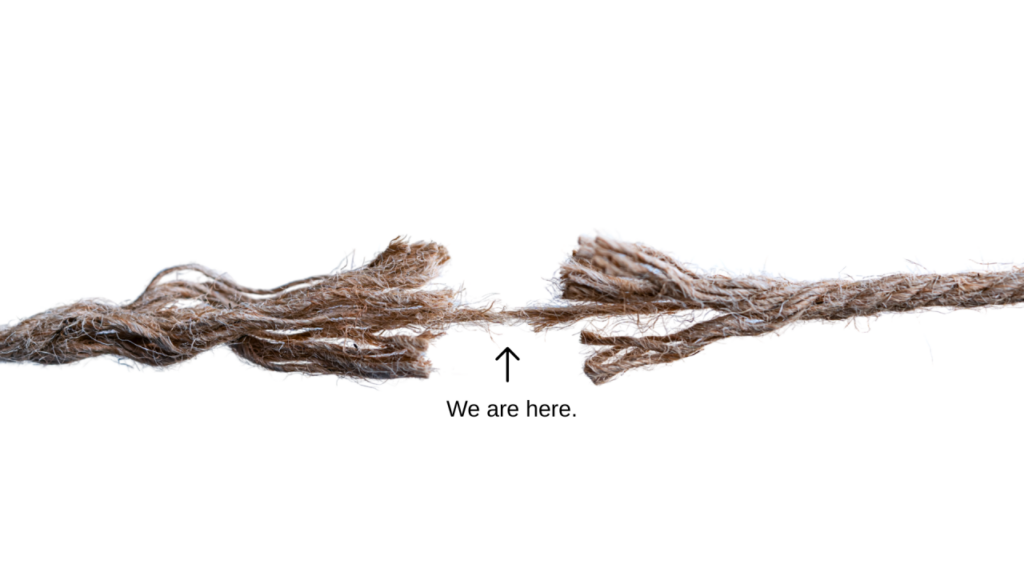
The job world is a mess.
Or a dumpster fire.
Or in transition.
Or all three.
Probably all three.
Let’s go to the data.
- U.S. hiring rates have dropped to their lowest level since 2014 (BLS JOLTS, 2024).
- There are 25–35% fewer job postings than two years ago (Indeed Hiring Lab, 2024).
- Job openings are down 1.5 million year-over-year (BLS, 2024).
Everyone’s looking for signs of recovery.
When will hiring pick back up?
When will the market stabilize?
When can we get back to normal?
Wrong questions.
That’s like farmers in 1920 saying, “Sure, tractors are nice, but how soon can we go back to mules?”
Innovation happens. Change happens. And when it does, we don’t reverse course.
We resist it. We fear it. We try to freeze ourselves in place.
But backward? That’s not on the menu.
So let me say this plainly:
The full-time job as we’ve known it for fifty years isn’t temporarily disrupted.
It’s collapsing.
And we are not going back.
The ship has sailed.
The cat’s out of the bag.
The jig is up.
It all feels sudden. But the clues were here long before the wheels came off.
Here are the three signs the “one job, one paycheck” model was breaking long before AI or layoffs showed up in the headlines.
Clue Number One: AI Waltzes In to Almost Zero Resistance
If technology can step in and start doing the work with barely a bump in the road, the work was vulnerable.
AI is walking into entry-level roles saying, “These are mine now.”
And it’s not stopping there.
It’s leaking upward — into management, C-suites, creative departments, research, analysis, operations, finance.
AI wants it all. And it will take most of what it wants.
But it cannot take the human stuff:
Judgment. Leadership. Lived experience. Scars. Wisdom.
Still, the solid job, steady paycheck, punch-your-time-card life had a few leaks in its waders.
And AI has exposed them.
Clue Number Two: Job Search Has Become Normalized Insanity
It can take half a year to a full year to find a job. Or more.
And more and more often, all that labor yields nothing.
Great talent sits idle because the systems and norms of job finding are, frankly, nuckin’ futz.
Recruiters. Job descriptions. ATS systems.
The endless loop of “final interviews.”
It’s a century-old telephone game with bad reception.
Companies struggle to articulate what they need, so they articulate everything.
Candidates struggle to signal what they offer.
Yet everyone pretends the system makes sense.
It doesn’t.
Back to the data:
- Job searches now average 22+ weeks; senior professionals: 9–12 months.
- Senior roles attract 250–700 applicants; fewer than 2% get past ATS, and under 0.5% reach a hiring manager.
- ATS systems reject up to 75% of qualified candidates automatically.
- Job descriptions list 22–26 required skills, many impossible to find in one human.
- Recruiters juggle 30–40 open roles, reviewing résumés for under 2 minutes.
That’s not a slow market.
That’s a broken machine.
Clue Number Three: Mass Layoffs at Profitable Companies
When a company pulls in billions and still cuts thousands, they’re revealing an ugly truth — or an error in the source code. I’m not sure which.
Laying off without pain or penalty tells you the employment model was getting shaky.
But let’s be clear: there is pain and penalty — just not at the shareholder level.
The penalty doesn’t disappear. It gets transferred.
Profitable companies can cut thousands with zero damage at the top.
Stock goes up. Margins improve. Analysts cheer.
Leaders call it “efficiency,” as if they reorganized a closet instead of detonated lives.
But workers absorb it.
Families absorb it.
Communities absorb it.
Schools, main streets, and small businesses feel the aftershocks for years.
The data backs it up:
- Workers face a 20–30% permanent income loss after a layoff.
- Anxiety, depression, and health issues spike 200–300%.
- Communities experience falling home values, shrinking tax bases, and 3–5 years of economic drag.
- Stress spreads to spouses, partners, and kids.
- Meanwhile, 72% of companies see stock prices rise within 60 days of layoffs.
There is no pain at the top of the spreadsheet.
All the pain happens underneath it.
What This Actually Means
Put these clues together and you get the real picture:
The old model wasn’t always broken.
It worked — beautifully — for a long time.
It created stability, dignity, and upward mobility.
But eras change.
Technology shifts.
Economics shift.
People shift.
And the systems built for one era rarely survive the next unchanged.
I return you to the picture attached to this article:
We don’t harvest much with mules anymore.
What we’re experiencing isn’t a failure.
It’s a transition — a massive one.
Over time, the full-time model drifted out of alignment with the world around it.
Slowly. Quietly. Decade by decade.
And then it hardened — a Pompeii of its own making — frozen in place by its own cement of:
- tasks instead of judgment
- roles instead of value
- headcount instead of contribution
- filters instead of understanding
- and processes that can’t distinguish a high-signal human from a keyword-stuffed résumé
The wheels didn’t suddenly come off.
They were loosening for years.
The “collapse” we’re seeing is simply the moment the structure could no longer pretend to hold.
And now we’re standing in that rubble calling it a “downturn,” as if this is temporary — as if this is a cold front instead of a climate shift.
No one caused this.
This is just where the dominoes fell.
And the broken part isn’t AI.
It isn’t layoffs.
It isn’t job search.
The broken part is that we’re trying to fix the future using the same tools that broke in the past.
This isn’t collapse for collapse’s sake.
This is the old model giving way to the next one.
The Trough Between Crests
Looking at the data and the mood of the work market may make it seem like dark times. But it’s only dark because we’re in a trough — the low point between two waves.
The old full-time model had its moment.
And it was a good moment.
It built the middle class.
It created stability and possibility.
It supported families and entire communities.
But the world changed faster than it did.
Technology accelerated.
Markets sped up.
Automation reshaped work.
People’s expectations evolved.
The old model kept trying to solve modern problems with industrial-era tools.
This trough is simply the space between what used to work and what will work next.
Waves don’t stay at their crest.
They rise.
They break.
They recede.
And then a new one forms behind them.
We’re watching the receding.
That’s all this is.
We are not going back to mules.
We are not going back to “one job, one paycheck.”
And if you stop mourning what’s collapsing long enough to look up, you’ll see the next wave already forming.
Three Signs of What’s Coming
1. Companies Are Moving Toward Flexibility
Because the world is moving too fast for rigidity.
Modern business requires:
- range
- speed
- adaptability
- on-demand capability
Full-time headcount was built for factories, headquarters, and multi-year planning cycles.
Today’s world moves in days and weeks.
I make the case for the Fractional work model all the time and I’ll do it here. Fractional isn’t cheaper labor.
It’s adaptive capacity — the right tool for a faster era.
2. People Are Moving Toward Freedom
Not out of rebellion.
Out of evolution.
The old promise — stay loyal and the company will take care of you — belonged to a different era.
People want:
- autonomy
- optionality
- diversification
- sovereignty over time and energy
- control of their earning power
A paycheck that can vanish on an earnings call isn’t security.
Freedom is security.
3. Wisdom Is Becoming the New Currency
AI is absorbing tasks at scale.
But it can’t absorb:
- judgment
- discernment
- leadership
- pattern recognition
- emotional intelligence
- the ability to steady a room during uncertainty
Companies don’t need more task-doers.
They need interpreters of reality — people who turn noise into meaning.
This is the very nature of Wisdom Workers. This the foundation of Fractional as a talent model.
And the demand for it is rising fast.
The Next Crest
Those waiting for the old world to return will drown in the trough.
Those who evolve with the shift — who build capability, freedom, and wisdom — will ride the next crest all the way up.
The question isn’t whether the future is bright.
It is. It always is.
The question is whether you’re willing to change enough to meet it.
I hope you do.
John